What to Test and How Often

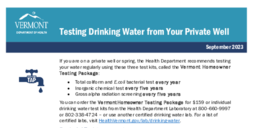
If you use a private well or spring, the Health Department recommends:

  • Every year: Test for bacteria (Total Coliform and E. coli) using Kit A.
  • Every five years: Test for bacteria, inorganic chemicals and gross alpha radiation using the Homeowner Testing Package.

The Homeowner Testing Package includes three test kits and checks for 15 common drinking water contaminants in Vermont. It also includes the bacteria test kit, so you can use it for that year's annual bacteria testing.

Quick Tip

Do you have a different water source or situation?


How to Test Your Water

Follow these steps to test your drinking water yourself. Please note that the details described in this section are for testing through the Vermont Department of Health Lab. If you choose to use another certified drinking water lab, please follow their instructions.

1. Order your test kits

You can order test kits online through the Vermont Department of Health Lab's webstore or by phone at 802-338-4724.

Homeowner Testing Package

This package includes three test kits for common drinking water contaminants:

  • Bacteria (Kit A): $14
  • Inorganic chemicals (Kit C): $100
  • Gross alpha radiation (Kit RA): $45

This recommended testing costs about $3.60 per month over five years, including annual bacteria testing.

Reminder: Test for bacteria every year. The package includes one bacteria test, so you'll need to order Kit A separately in the other four years.

Order the Bundled Kit: Homeowner Testing Package

New Well or Spring Testing Package

Vermont has specific testing requirements for new wells and springs. Review the new well and spring testing guidance before ordering a package. 

Order the Bundled Kit: New Well or Spring Testing Package

Test kits for specific contaminants

You can also order individual test kits (for example, a lead test kit). 

Order Individual Test Kits (a la carte)

2. Collect your samples

Collect the samples the same day you plan to return them to the Lab. Follow the instructions that come with your test kit. Incorrectly collected samples may not be accepted by the Lab. 

Using the bottles provided by the Lab, collect your samples from the faucet you most often use for drinking and cooking, usually the kitchen sink. Don't use a bathroom or utility sink or an outdoor hose. 

Using the Homeowner Testing Package?

You'll receive four sample bottles. The instructions vary by bottle, and here are some tips.

  • 1 medium (250-milliliter) bottle: Do not use water in your home for at least 8 hours before collecting the sample. The Lab recommends collecting it first thing in the morning.
  • 1 small (100-milliliter) bottle: This bottle contains a preservative. Do not rinse it out. We recommend sanitizing the faucet with rubbing alcohol before collecting this sample.
  • 2 large (1-liter and 500-milliliter) bottles: Follow the instructions provided with your kit.

Watch the video below for a demonstration of how to collect samples using the Homeowner Testing Package. Always follow the instructions that come with your specific kit, as they may differ.

3. Return your samples

Return your samples the same day you collect them. Some samples need to be kept cold, so follow the return instructions that come with your kit.

You can return your samples by:

  • Dropping them off at your nearest Local Health Office (Monday to Thursday, usually before noon).
  • Dropping them off at the Vermont Department of Health Lab.
  • Mailing or shipping them to the Lab using USPS, FedEx or UPS.

Find sample drop-off and shipping instructions

4. Get your test results

The Lab will email or mail your results when they are ready. 

Getting results by email

If you provide an email address, you will receive an email from [email protected] as each test is completed.

Typical turnaround times for the Homeowner or New Well Testing Packages:

  • Bacteria: within 1 to 2 business days
  • Gross alpha radiation: within 2 weeks
  • First draw lead: within 3 weeks
  • Inorganic chemicals, including uranium, fluoride and nitrate: within 2 to 4 weeks

These time frames begin when the Lab receives your samples and may vary.

Note: You’ll receive two lead results: a “first draw” result first, followed by a “flush” result (with your inorganic chemical results) up to two weeks later. Lead is detected more often in first draw samples.

Getting results by mail

If you request mailed results or don't provide an email address, the Lab will mail all your results together after all testing is complete. This usually takes 3 to 4 weeks after the Lab receives your samples.

Questions about the tests you ordered or about a rejected sample? Call the Lab at 802-338-4724 or 800-660-9997 (toll-free in Vermont).


Making Sense of Your Test Results

Your test results show what the Lab found in your water and whether any results need attention. How to read your results depends on the type of test.

Bacteria (Kit A)

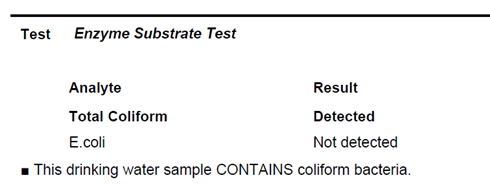
Your results will include separate results for Total Coliform and E. coli.

If either is detected, bacteria are present in your water. Follow the Health Department's guidance for disinfecting your well or spring and retesting your water.

See an example of bacteria test results.

Inorganic chemicals (Kit C or Kit ID for new wells)

Your results list the chemicals tested. If a chemical is present at a level of concern, the far-right column will say “Above Threshold.” 

Review the results carefully to see which chemicals need attention and what steps to take next.

See an example of inorganic chemical test results.

Gross alpha radiation (Kit RA)

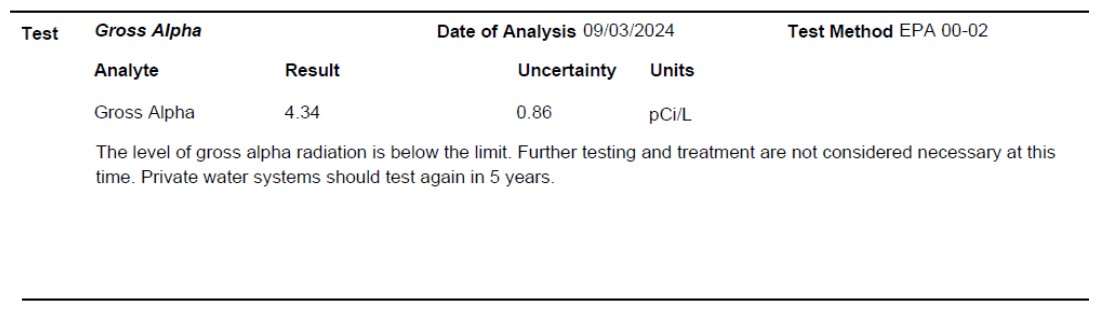
Gross alpha radiation measures radioactivity in water from naturally occurring elements, such as uranium and radium. 

A result below 5 picocuries per liter (pCi/L) is not considered a health risk. If your result is above 5 pCi/L, check your uranium result from Kit C and follow the Health Department's guidance for interpreting your results.

See an example of gross alpha radiation test results.


When a Result Needs Attention

The next steps depend on the contaminants and the amount detected. You may need to treat your water to reduce or remove contaminants.

Before buying a treatment system, make sure you have all your test results (four Lab reports if you ordered the Homeowner or New Well Testing Packages). Different contaminants require different treatments, so it's important to understand the full picture of what's in your water before choosing a system. 

Learn how to treat your drinking water

Retesting after installing treatment

After installing a treatment system, we recommend retesting your water for the contaminants that came back above recommended levels to make sure the treatment is working. 

You can order individual tests through the Health Department Lab’s online webstore. Tests cost $10 to $45, depending on the contaminant. If you can't order online, call 802-338-4724 or 800-660-9997 (toll-free in Vermont).

Order Individual Test Kits (a la carte)

Questions? Contact us.


Drinking Water Contaminants

What the Homeowner Testing Package tests for

The Homeowner Testing Package checks for many common contaminants in Vermont drinking water. Learn about why you should test, possible sources, how often to test, and when to treat your water.

Arsenic
  • Why test? Arsenic increases your risk of bladder, lung or skin cancer.
  • Possible sources: Naturally occurring in some bedrock and soils in Vermont
  • How often to test: Every five years
  • When to treat your water: When arsenic levels are at or above 0.001 mg/L

Learn more about arsenic in drinking water

Bacteria (total coliform and E. coli)
  • Why test? Coliform bacteria may cause stomachaches, diarrhea and gastrointestinal (GI) diseases. If bacteria are present in your water, surface water or runoff may be getting into your water supply. You may need additional testing to identify the source.
  • Possible sources: Surface water intrusion, wastewater from septic systems, and agricultural runoff
  • How often to test: Every year. If bacteria are detected, consider testing for nitrates if you haven't already.
  • When to treat your water: When any amount of total coliform or E. coli bacteria is detected.

Learn more about bacteria in drinking water

Chloride
  • Why test? Chloride may indicate that other contaminants are present in the water.
  • Possible sources: Wastewater from septic systems and road salt
  • How often to test: Every five years
  • When to treat your water: When chloride levels are above 250 mg/L

Learn more about chloride in drinking water

Copper
  • Why test? Copper may cause stomachaches, vomiting, diarrhea and liver damage in young children.
  • Possible causes: Leaches from plumbing and fixtures when water is corrosive
  • How often to test: Every five years
  • When to treat your water: When copper levels are above 1.3 mg/L

Learn more about copper in drinking water

Fluoride
  • Why test? Fluoride levels above 4 mg/L can cause bone disease. Levels above 2 mg/L can cause staining or pitting of teeth. An optimal level of 0.7 mg/L helps prevent tooth decay.
  • Possible sources: Naturally occurring in some bedrock and soils in Vermont
  • How often to test: Every five years
  • When to treat your water: When fluoride levels are above 0.7 mg/L
Gross alpha radiation
  • Why test? Gross alpha radiation increases your cancer risk.
  • Possible sources: Naturally occurring in some bedrock and soils in Vermont
  • How often to test: Every five years
  • When to treat your water: For any result above 5 pCi/L, use the adjusted gross alpha calculator to find out if you need to do other testing.

Learn more about gross alpha radiation in drinking water

Hardness
  • Why test? Hardness poses no health risk. It can cause scale buildup in plumbing and gray staining of washed clothes.
  • Possible sources: Naturally occurring in some bedrock and soils in Vermont
  • How often to test: Every five years
  • When to treat your water: Treatment is optional because hardness is not a health risk. For levels at or above 150 mg/L, you may choose to soften your water to reduce scale buildup. You may also need to soften your water before using some treatment systems to address other contaminants.

Learn more about hardness in drinking water

Iron
  • Why test? Iron poses little to no health risk. It can make your water smell or taste bad and can stain your plumbing fixtures and clothes.
  • Possible sources: Naturally occurring in some bedrock and soils in Vermont
  • How often to test: Every five years
  • When to treat your water: Treatment is optional because iron is not a health risk. For levels above 0.30 mg/L, you may choose to treat to improve the taste or reduce staining.

Learn more about iron in drinking water

Lead
  • Why test? Lead can damage the brain and nervous system, slow growth and development, and cause learning, behavior, hearing and speech problems, especially in young children and during pregnancy.
  • Possible sources: Leaches from plumbing and fixtures when water is corrosive
  • How often to test: Every five years
  • When to treat your water: When lead levels are at or above 0.001 mg/L

Learn more about lead in drinking water

Manganese
  • Why test? When consumed over a long time, manganese can damage the nervous system, affecting memory, attention and motor skills. Infants may develop learning and behavior problems.
  • Possible sources: Naturally occurring in some bedrock and soils in Vermont
  • How often to test: Every five years
  • When to treat your water: When manganese levels are above 0.300 mg/L. Lower levels can cause staining.

Learn more about manganese in drinking water

Nitrate/Nitrite
  • Why test? High nitrate or nitrite levels can cause methemoglobinemia ("blue baby syndrome") in infants, which reduces the blood’s ability to carry oxygen. Babies under 6 months are especially at risk.
  • Possible sources: Fertilized agricultural fields, wastewater from septic systems, and compost piles
  • How often to test: Every five years. If nitrate levels are at or above 5 mg/L, test every three to six months.
  • When to treat your water: 
    • Nitrate: When levels are above 10.0 mg/L. If levels are at or above 5.0 mg/L, we recommend treatment to protect babies under 6 months old. 
    • Nitrite: When levels are at or above 1.0 mg/L

Learn more about nitrate and nitrite in drinking water

Sodium
  • Why test? Sodium may indicate that other contaminants are present in the water. Sodium can be harmful to people on low-sodium diets.
  • Possible sources: Wastewater from septic systems, road salt and water softeners
  • How often to test: Every five years
  • When to treat your water: Consider treatment if sodium levels are above 250 mg/L, as the water may taste salty. If you or someone in your household follows a medically prescribed low-sodium diet, talk with your healthcare provider about sodium in your drinking water. The EPA recommends no more than 20 mg/L for people restricted to a total sodium intake of 500 mg per day.

Learn more about sodium in drinking water

Uranium
  • Why test? Uranium may cause kidney damage.
  • Possible causes: Naturally occurring in some bedrock and soils in Vermont
  • How often to test: Every five years
  • When to treat your water: When uranium levels are above 0.020 mg/L

Learn more about uranium in drinking water

Other contaminants you may want to test for

Depending on your well or spring and the land around it, you may need to test for contaminants not included in the Homeowner Testing Package.

Learn more about these contaminants and when additional testing may be appropriate:


Resources

Contact Us

Private Drinking Water Program

Phone: 802-489-7339

Email: [email protected]

Rental Properties

Under Vermont’s Rental Housing Health Code, drinking water provided to tenants must be free from harmful levels of contaminants. If you are the landlord of a rental unit that uses a private well or spring, the only way to know your tenants' water is free of contaminants is to test it.

If you are a landlord:

  • Test the private water source provided to your tenants following the Health Department’s recommended private drinking water testing schedule. Test each private water source with the Homeowner's Testing Package every five years and for bacteria every year.
  • If you own a property with multiple units supplied by the same well or spring, test for first draw lead at the main faucet used for drinking water in each unit. The Homeowner's Testing Package includes one first draw lead test, so you may need to order additional lead tests separately.
  • If levels of contaminants are found above Health Department drinking water standards, find out what treatment options are available.
  • The Health Department recommends contacting a water treatment specialist for up-to-date treatment information and estimates.

You may qualify for financial assistance to fix health and safety issues, including water treatment:

  • Champlain Housing Trust Landlord Loans are available in Chittenden, Franklin and Grand Isle counties. These loans are available for owner-occupied buildings up to 4 units, single family rentals, duplexes and accessory dwelling units.
  • NeighborWorks of Western Vermont offers Rental Repair Loans to landlords of 1 to 4 rental unit properties in Addison, Bennington and Rutland counties.

Order test kits

If you are a renter:

  • Ask your landlord to show you results of a recent water test completed at the Department of Health Laboratory or another certified drinking water lab. If your landlord has not tested your water recently, ask them to test at one of these labs.
  • If you are unable to ask your landlord to test your water, contact the Division of Fire Safety for help.
Last Updated: