What is Legionella?

Legionella is a type of bacteria that is found in water and wet environments. Under the right conditions, it can grow in the plumbing of buildings or in water features. When people inhale water droplets containing Legionella from sources such as showers, hot tubs, cooling towers, or medical equipment, they can develop Legionnaires’ disease, a serious and sometimes fatal type of pneumonia.

Did you know?

People over the age of 50, those with chronic lung conditions or weakened immune systems, and people who smoke or used to smoke are especially at risk for Legionnaires’ disease.

Causes of Legionella Growth in a Building's Plumbing

  • Biofilm, which is slime that provides a place for germs to grow.  
  • Water temperatures of 77°F to 113°F are the ideal range for Legionella growth.
  • Areas of plumbing with slow or no water movement, like fixtures that are not used often or pipes that have been capped off. This allows biofilm to form and depletes chlorine levels.
  • Not enough chlorine or other disinfectants in the water. Public water systems add disinfectants, like chlorine, to kill germs that can make people sick. Disinfectants get used up as they travel through the water system and sit in a building’s plumbing.

Having an effective water management program can help control these causes and decrease Legionella growth.

Types of Buildings and Features That are High Risk for Legionella Growth

All buildings carry some risk of growing and spreading Legionella, but some buildings and components are more likely to than others. Even buildings using public water with an added disinfectant can have Legionella growth.

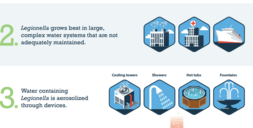
Building features like cooling towers, hot tubs, whirlpool spas and decorative fountains are often responsible for Legionella outbreaks. They often keep water features in the favorable Legionella growth zone of 77°F to 113°F and create water droplets that someone can breathe in.

Large buildings with complex water systems

Large buildings with complex water systems include hotels, bed and breakfasts, hospitals or condominiums. Because of the building’s size, it can be difficult to maintain high enough water temperatures and disinfectant levels, or to make sure taps and fixtures are regularly flushed. Large buildings may also have fixtures or devices that require regular servicing (for example, cooling towers, hot tubs, decorative fountains).  

Health care settings  

Hospitals, long-term care facilities, and other health care facilities serve populations that are especially vulnerable to Legionella infections. Health care settings are required by the Centers for Medicare and Medicaid to have water management programs to reduce the growth and spread of Legionella.

Buildings with variable or seasonal occupancy

In buildings with variable or seasonal occupancy, Legionella can grow in the plumbing during periods of low use.


Water Management Programs

Preventing the conditions that allow Legionella to grow is the best way to reduce the risk of Legionnaires disease. The Centers for Disease Control and Prevention (CDC) recommends that buildings with complex water systems develop a water management program.  

Water management programs (WMPs) help to identify areas and devices in buildings where Legionella growth, spread or transmission may occur and detail strategies on how to prevent it. WMPs are now the industry standard for many buildings in the United States to minimize the risk for Legionella and other germs associated with a building’s plumbing.

Quick Tip

Take this free training on how to prevent Legionella growth and how to develop or improve a water management program for your building.

Seven Steps of an Effective Water Management Program

The CDC recommends following a 7-step framework when developing a WMP. Below are summaries of each step and a direct link to that step in the CDC’s toolkit for more detailed information. We’ve also included some tips and questions for you to consider as you are developing your WMP. 

Download the CDC’s full toolkit: Developing a Water Management Program 

1. Establish a water management team

Clearly define who is on the team and which tasks they are responsible for. The number of people and who is on the team will vary depending on the size of the building, what types of devices and plumbing fixtures are present, and the type of setting (health care versus hotel).  

  • For example, most buildings should include representatives, like the building owner/manager/administrator, maintenance or engineering employees, contractors/consultants, and safety officers.  
  • For health care facilities, the team should also include members from infection prevention, clinical services, microbiologists, environmental services and engineering when establishing the team.

Go to step 1 in the CDC’s toolkit 

2. Describe the facility's water systems

Use detailed diagrams and schematics to trace the flow of water from the point of entry to all outlets and fixtures.

  • Where is your water coming from? A public water supply or your own private well or spring?
  • If it is a public water supply, who is your contact at the public water supply?
  • Does the public water supply add a disinfectant? Which one? What are the disinfectant levels at the sampling locations closest to your facility?

Go to step 2 in the CDC’s toolkit 

3. Identify areas where Legionella could grow and spread

Look for locations where water may stagnate, places where temperatures are between 77°F and 113°F, and for devices that produce mists or splashing (aerosols).  

  • Does your facility have showers, cooling towers, decorative fountains, or hot tubs? These sources are known to spread Legionella.
  • Does your facility have rooms or fixtures that aren’t used for stretches at a time? These are places where Legionella can grow in your system, sometimes called “dead legs.” Examples include:
    • Eye wash stations
    • Water fountains or bathrooms that aren’t used
    • Lines of plumbing that have been capped off
    • Sprinkler systems that are attached to the drinking water system

Go to step 3 in the CDC’s toolkit 

4. Decide where to apply control measures and how to monitor control limits

Use the CDC’s Legionella Control Toolkit to identify how to limit the growth and spread of Legionella (for example, flushing, cleaning, disinfecting) at each of the areas identified in Step 3. This toolkit includes information for potable water systems as well as high risk sources like cooling towers and hot tubs.

Potable water systems

  • Set hot water heaters to at least 140°F so water at the taps is between 113°F and 120°F.
  • Make sure cold water stays below 77°F.
  • Make sure there is a disinfectant residual of at least 0.1 parts per million (ppm) throughout your facility. A disinfectant residual is the amount of disinfectant that is available to kill germs.  
    • If your building is on public water, check with the system operator to see if they disinfect and what disinfectant they use, so you will know what to measure.  
    • Choose a method that can measure chlorine in the appropriate range.  
      • Chlorine tests strips, DPD/Color discs tests or a handheld spectrophotometer can be used for these measurements.  
      • Pool test kits usually are not sensitive enough for measuring disinfectant residuals in potable water.  
  • Consider supplemental disinfection if you aren’t able to achieve a disinfectant residual of 0.1 ppm. This requires a permit from the Department of Environmental Conservation.  
  • Flush infrequently used fixtures at least weekly.  
  • Check water parameters regularly throughout the facility and keep records of the parameters.  

Non-potable water systems

The CDC also outlines considerations for systems that use non-potable water, which is water not used for drinking or showering.  

Go to step 4 in the CDC’s toolkit 

5. Establish interventions when control limits aren't met

Take corrective actions when needed. Have a written plan for how to respond when control limits are not met, like flushing, disinfection, or increasing temperatures. For example:

  • If there is no disinfectant residual at a given fixture, you may need to do additional flushing and monitoring.  
  • If temperatures measured at a tap are repeatedly below 113°F, consider adding additional thermostatic mixing valves closer to the tap. Thermostatic mixing valves blend hot and hold water to keep the water hot while making sure the water from the tap isn’t hot enough to burn you.

Go to step 5 in the CDC’s toolkit 

6. Make sure the program runs as designed and is effective

Make sure staff are correctly implementing the program.  

  • Monitor water quality parameters like disinfectant residual, pH, and temperature.  
  • Update the program when water parameters are not adequately controlling Legionella.  
  • Regularly test for Legionella bacteria if high-risk populations live in your building.

Go to step 6 in the CDC’s toolkit

7. Document and communicate all the activities

Be sure to update the program documentation as your water system changes and requires different control points, control measures and corrective actions.

Go to step 7 in the CDC’s toolkit

ASHRAE Standard 188 and ASHRAE Guideline 12 offer detailed building-specific guidance that is recommended for all large buildings. The CDC also has an accompanying guide on how to implement this framework.

Consider working with a Legionella consultant if you need help developing your water management plan or identifying solutions for your facility.

Best Practices for Implementing a Water Management Program

To help prevent Legionella growth, we recommend regularly following these best practices:

Flushing Protocols  

  • Flush low-use fixtures to prevent water stagnation.  

Preventive Maintenance

  • Clean and descale hot water tanks, storage vessels, and ice machines on a regular schedule.  

Temperature Monitoring and Use of Mixing Valves  

  • Check the hot water temperature throughout the building.  
  • Make sure circulating hot water maintains a temperature between 120°F and 140°F.
  • Recirculate the hot water if possible.  
  • Use thermostatic mixing valves close to the tap to prevent scalding while keeping the circulating hot water temperature high.

Disinfectant Residual  

  • Regularly check the disinfectant residual to make sure it can be detected everywhere in the building’s water system, especially at the farthest outlets (for example, taps furthest from where the water enters the building).  
  • Check the disinfectant levels in pools, hot tubs and cooling towers.  

Environmental Assessment  

  • If you have a building with complex plumbing fixtures or devices, do a detailed environmental assessment so you know where the high-risk areas for Legionella growth are.  

Environmental Testing 

Periodically test for Legionella in high-risk areas or during outbreak investigations.

Communication

  • Keep your water management program documents and associated materials in an easy-to-find place.  
  • Make sure staff are trained in recognizing and responding to risks.

Special Considerations

  • Construction/Renovation: New plumbing, water outages or strong building vibrations can dislodge biofilms in the plumbing that can lead to Legionella growth. Be sure to flush and test before and after construction.
  • Outbreak Response: If someone associated with your facility is diagnosed with Legionnaires’ disease, work with the Vermont Department of Health on communication and mitigation strategies.  

Training Resources

Quick Tip

Need help?

If you need a water management program or an environmental assessment for your building, consider working with a Legionella consultant. The CDC offers advice on things to consider when selecting a consultant.

Last Updated: