Mercury in Fish

People who are nursing, pregnant or planning to be, and children under age 6 should eat fish with low mercury levels. 

  • Mercury is a toxic metal that is harmful to a developing nervous system. 
  • Too much mercury can affect your child’s brain and how your child learns, moves and behaves. 
Mercury in Fish Safe Eating Guidelines

The mercury in fish safe eating guidelines can help you decide what types of fish to eat, how much to eat and how often based on their mercury levels. 

  • The safe eating guidelines are for fish fillets. 
  • Dried fish, whole fish or other parts of the fish (for example, the fat, head, skin, bones, eggs or organs) have not been tested for mercury. 

Be sure to follow the waterbody-specific advisories for other contaminants if you eat fish caught from Lake Champlain, the Hoosic River, the Deerfield and Connecticut Rivers, or Lake Memphremagog. 

Fish You Catch in Vermont

Fish You Buy in Stores or Online

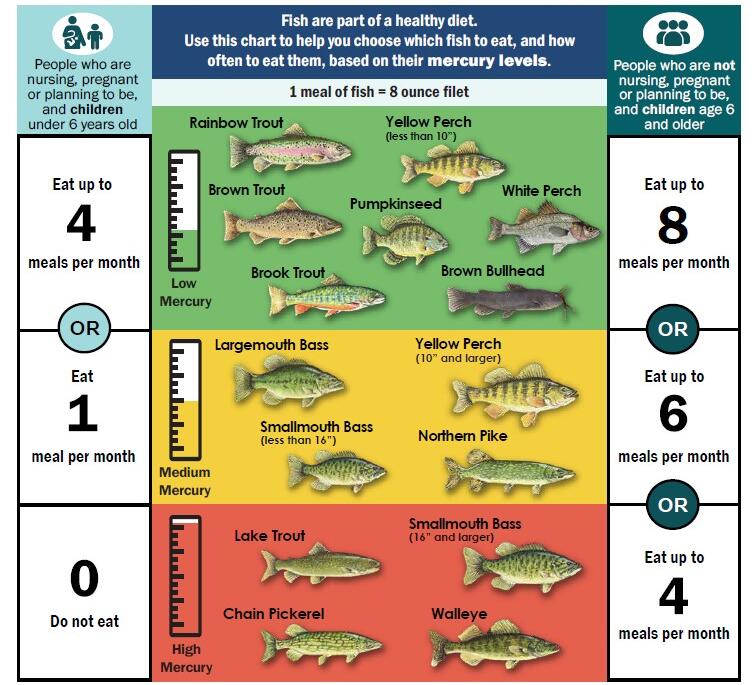
Fish You Catch in Vermont Safe Eating Guidelines
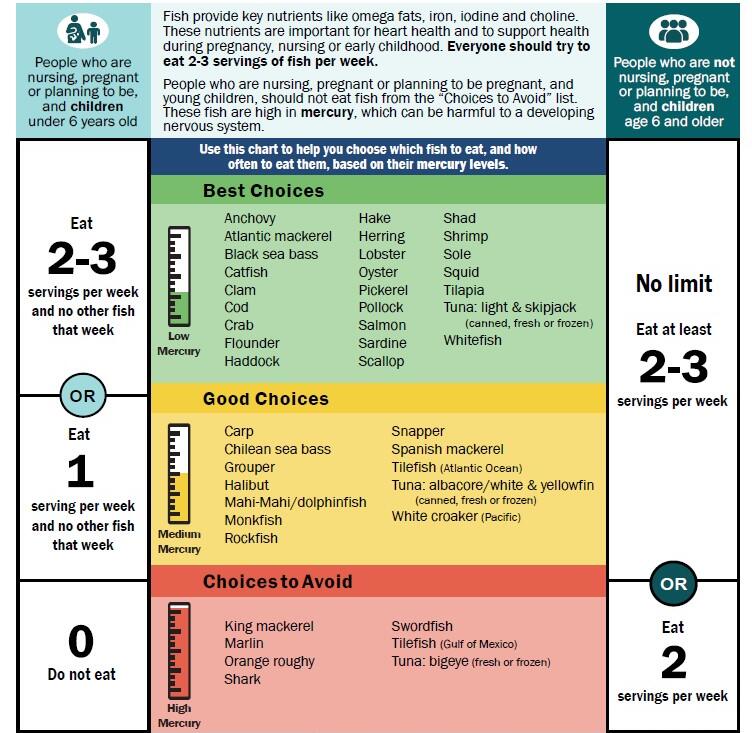
Fish You Buy Safe Eating Guidelines

For fish you catch in Vermont waters:

  • The meal size is an 8-ounce skinless fillet. The safe eating guidelines show how many fish meals you can eat per month
  • If you reach the meals per month limit, eat no other fish that month. 
  • If you do not reach the limit, then you can eat additional servings of fish you buy. 

For fish you buy in stores or online:

  • The serving size is based on the size of the palm of your hand. That means children are eating smaller serving sizes than adults. 
  • The safe eating guidelines show how many servings you can eat per week.

You don’t have to be exact when figuring out how much fish to eat. These guidelines are averages, so it’s okay if you eat a little bit over the limit for one week. You can eat lower-mercury fish the following week. 

Download the mercury in fish safe eating guidelines
Download a text-only version

Are you a health care provider? Use our online order form to get professionally printed versions of the safe eating guidelines to give to your patients.

Order the Vermont Eat Safe Fish Card

Quick Tip

If you need help figuring out how to combine meals of fish you catch and fish you buy, check out the fish meal mercury calculator. The calculator has average mercury levels for most common fish species.

Fish Meal Mercury Calculator


How to Prepare Fish

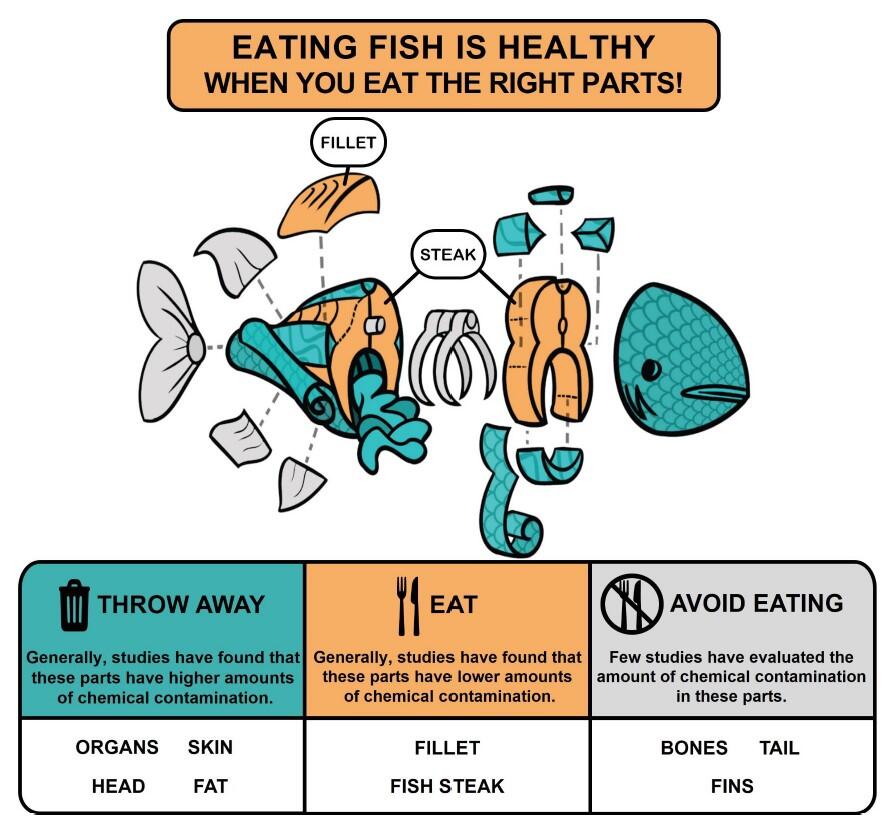
Mercury or other contaminants can build up in other fish parts. 

  • When you are preparing fish, throw away the head, skin, fat and organs (guts) of the fish.

  • Try not to use these parts for stocks, sauces, soups, stews, etc. Eat fish eggs or roe occasionally. 

  • The image below shows you which parts to throw away, which parts to eat, and which parts to avoid eating.

Check out some how-to videos and tips on cleaning, prepping, and filleting fish you catch

which parts of fish to eat and which parts to throw away

العربية  (Arabic) Chinese-Mandarin Français (French) Español (Spanish) Tiếng Việt (Vietnamese)


Other Fish Contaminants

Fish may contain other contaminants besides mercury. Be sure to check the waterbody-specific advisory section if you eat fish caught in Vermont.

PCBs

Polychlorinated biphenyls (PCBs) are a group of human-made chemicals that can cause serious health problems and harm the environment. 

  • PCBs break down very slowly and can remain in the environment for a long time. 
  • The U.S. Environmental Protection Agency (EPA) banned manufacturing and certain uses of PCBs in 1979. 

Even though PCBs are banned, they can still be found in fish. Check the waterbody-specific advisory section for PCB advisories. Learn more about the health effects of PCBs.

PFAS

The Department of Environmental Conservation (DEC) monitors Vermont waters and fish tissue for perfluoroalkyl and perfluoroalkyl substances, commonly known as PFAS. 

  • To date, PFAS levels in surface water and fish tissue are low compared to national levels.
  • They are also similar to concentrations from non-impacted waterbodies in Maine and New Hampshire. 

At this time, there are no fish advisories for PFAS in Vermont.


Waterbody-specific Advisories

Here are the Vermont waterbodies that have specific guidelines for eating fish.

Lake Champlain

Lake Trout in Lake Champlain may contain PCBs. 

  • People who are pregnant, planning to be, or are nursing, and children under age 15 should not eat any lake trout from Lake Champlain.
  • Everyone else should limit lake trout (over 25 inches) caught in Lake Champlain to one meal (8-ounce fillet) per month. 
Hoosic River

Because of PCB contamination, there is a “Do Not Eat” advisory for all fish species from the Hoosic River. 

No one should eat any fish caught from the Hoosic River. 

Deerfield and Connecticut Rivers

This advisory is for fish caught in Deerfield River’s chain of reservoirs (Grout Pond and the Somerset, Harriman, Sherman and Searsburg Reservoirs) and the Connecticut River’s Comerford and Moore Reservoirs. The hydroelectric dams on some of these reservoirs create environmental conditions that may cause higher levels of mercury in fish. 

  • People who are pregnant, planning to be, or are nursing, and children under age 6 should not eat any fish from these waterbodies. 
  • Everyone else should limit fish caught in these reservoirs to two fish meals (8-ounce filet) per month.
Lake Memphremagog

We recommend not eating fish showing obvious signs of disease, including bullhead with obvious tumors.


Fish Contaminant Monitoring Committee (FCMC)

The Fish Contaminant Monitoring Committee (FCMC) guides Vermont’s work to sample fish for mercury and other harmful contaminants. The FCMC is made up of the departments of Health, Environmental Conservation and Fish & Wildlife. The FCMC helps decide if fish in Vermont are safe to eat.

Find out when the Fish Contaminant Monitoring Committee meets

Last Updated: