The substance use workforce is made up of people at all levels of experience and education, from all types of backgrounds, working in a wide range of settings.

Why choose a career in the substance use field?

  • Opportunities for growth and continual learning
  • Chances to make a difference every day
  • Rewarding teamwork
  • Impact how we prevent, treat and help people recover from substance use
  • Opportunity to work directly with people
  • Emphasis on equity, inclusion and diversity

What is it like to work in the substance use field?

There are many jobs you can do, places where you can work and people you can work with across the substance use field.

Whether you are preventing misuse, making sure that people who use substances are safer, helping people recover or providing medical or mental health treatment - you can make a difference.

Where could you work?

Examples of places you could work in the substance use field:

  • Schools
  • Doctor’s offices
  • Mental health offices
  • Treatment centers
  • Peer recovery support centers
  • Syringe service programs
  • Non-profit organizations
  • Town, city, state and federal government agencies
What could you do?

Examples of work you could do in the substance use field:

  • Provide counseling
  • Outreach to help get people into services
  • Case management
  • Recovery coaching
  • Develop prevention programming
  • Develop messaging campaigns
Who could you work with?

Examples of who you could work with in the substance use field:

  • Students
  • Parent
  • School administrators
  • Town boards
  • Community and non-profit organizations
  • Employers
  • People with substance use disorder
  • Legislators
  • Health care providers
  • Marketers

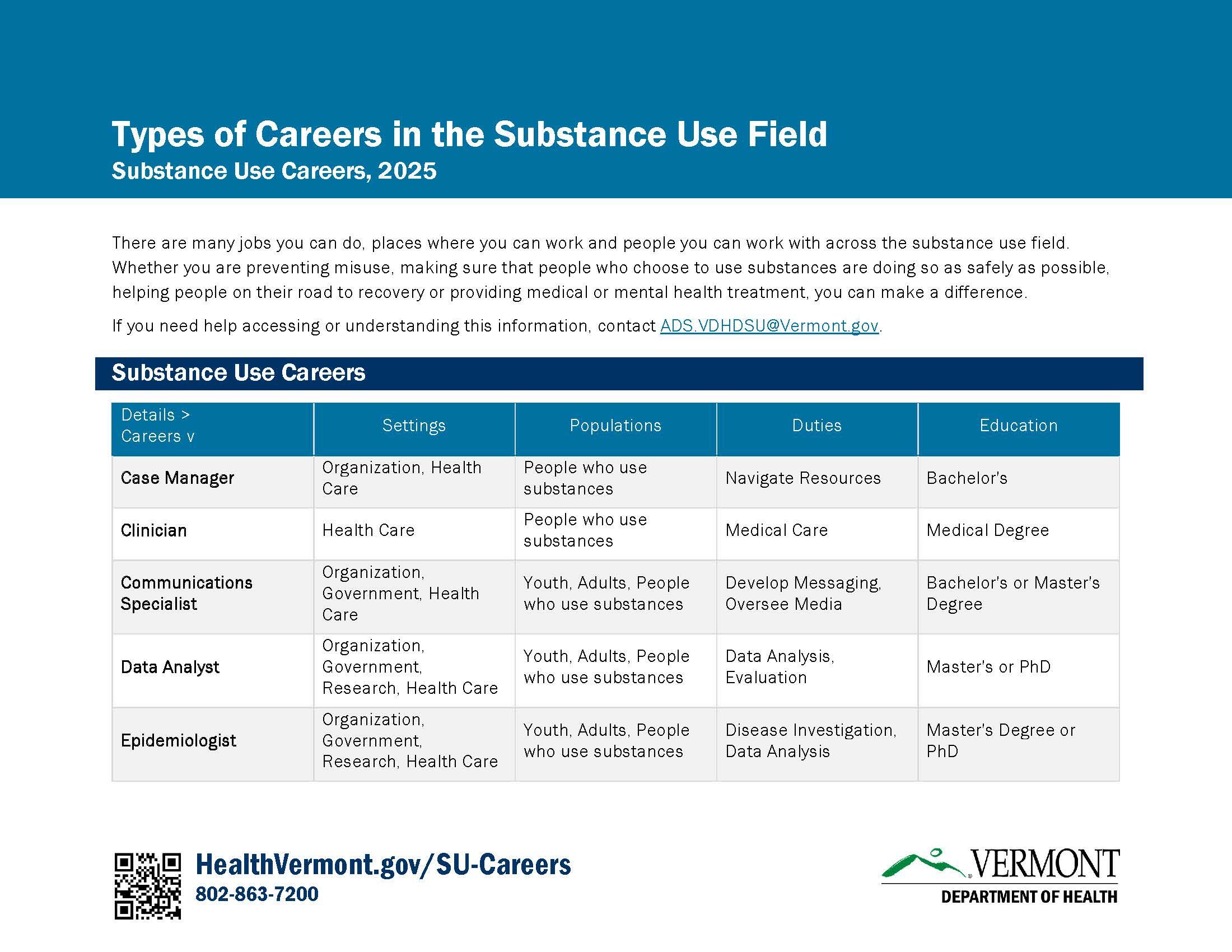
Example Careers in the Substance Use Field

Examples of substance use careers from across the continuum of care: prevention, communication, harm reduction, treatment and recovery.

Quick Tip

Use the "Search" bar to filter the table. Try "school" or "lived experience." 

CareerSettingPopulationDutiesEducation
Prevention EducatorSchoolsYouthEducation, Events, Student GroupsBachelor's or Associate's Degree
Program CoordinatorOrganization, Government, Health Care, SchoolYouth, Adults, People who use substancesProgram Development, Grant ManagementBachelor's or Master's Degree
Prevention ConsultantOrganization, GovernmentYouth, Adults, People who use substancesEducation, Events, Policy DevelopmentBachelor's or Master's Degree
School CounselorSchoolsYouthEducation, SupportBachelor's or Master's Degree
EpidemiologistOrganization, Government, Research, Health CareYouth, Adults, People who use substancesDisease Investigation, Data AnalysisMaster's Degree or PhD
Data AnalystOrganization, Government, Research, Health CareYouth, Adults, People who use substancesAnalyze Data, Evaluate EffectivenessMaster's or PhD
Research and Policy AnalystOrganization, Government, Research, Health CareYouth, Adults, People who use substancesReview Research, Inform PolicyMaster's Degree or PhD
Recovery CoachOrganization, Health CarePeople who use substancesPeer Support, Encourage Recovery, Navigate ResourcesLived Experience or Certification
Case ManagerOrganization, Health CarePeople who use substancesNavigate ResourcesBachelor's
Harm Reduction SpecialistOrganization, Health CarePeople who use substancesEducation, Safer Use Care, Navigate ResourcesLived Experience, Bachelor's Degree, or Medical License (e.g.: RN)
NurseHealth CarePeople who use substancesMedical CareBachelor's Degree and Registered Nurse License
ClinicianHealth CarePeople who use substancesMedical CareMedical Degree
Mental Health CounselorHealth CarePeople who use substancesMental Health CareMaster's Degree
Communications SpecialistOrganization, Government, Health CareYouth, Adults, People who use substancesDevelop Messaging, Oversee MediaBachelor's or Master's Degree
Program EvaluatorOrganization, Government, Research, Health CareYouth, Adults, People who use substancesEvaluate Program EffectivenessMaster's or PhD
Recovery Services SpecialistOrganization, Health CareYouth, Adults, People who use substancesEducation, Encourage Recovery, Navigate ResourcesLived Experience or Certification

Download the Substance Use Careers document.


Education and Credentials

Relevant to the substance use field

Examples of degrees, credentials and lived-experiences that are relevant for working in the substance use field.

Degrees

Examples of degrees that you could have that are relevant for working in the substance use field.

  • Behavioral Science
  • Biology
  • Clinical Mental Health/ Counseling
  • Emergency Medical Services
  • Epidemiology
  • Equity/ Restorative Justice
  • Global Health
  • Health Science
  • Human Services
  • Marketing/ Communication
  • Medical Science
  • Neuroscience
  • Nursing
  • Psychology
  • Public Administration
  • Public Health
  • Social Work
  • Sociology
  • Statistics
  • Trauma Studies
  • ...and more!
Degree Types
Degree TypeExamplesYears to CompletePrerequisites
Associates DegreeAA, AS, ASN2 YearsHigh School Diploma or GED
Bachelor’s DegreeBA, BS, BSN4 YearsHigh School Diploma or GED
Master’s DegreeMA, MS, MSN, MPH, MSW2-4 YearsBachelor's Degree
Doctorate DegreePhD, PsyD, EdD, DSW3-7+ YearsBachelor's or Master's Degree
Medical DegreeMD, DNP4-7+ Years
(often includes residency)
+ Licensure Exam*
Bachelor's or Master's Degree
Registered NurseRNLicensure Exam*Bachelor's Degree
Advance Practice Registered NurseAPRN, Nurse PractitionerLicensure Exam*Master's or Medical Degree
Credentials

Examples of credentials you could obtain that are relevant to working in the substance use field.

  • Apprentice Addiction Professionals
  • Certified Addiction Counselor
  • Certified Alcohol and Drug Counselors
  • Certified Prevention Specialist
  • Certified Recovery Coach
  • Licensed Alcohol and Drug Counselor

How to obtain these credentials:

Alcohol & Drug Counselors - AAP, CADC, LADC

The Vermont Secretary of State’s Office of Professional Regulation (OPR) is responsible for certification and licensure of Apprentice Addiction Professionals (AAP), Certified Alcohol and Drug Counselors (CADC), and Licensed Alcohol and Drug Counselors (LADC).

Alcohol & Drug Prevention Practitioners - CPS

Competency standards for substance use prevention practitioners are established by the International Certification & Reciprocity Consortium (IC&RC). For practitioners interested in becoming a Certified Prevention Specialist (CPS) contact the Vermont Prevention Certification Board.

Certified Recovery Coaches

Prevention Works! VT coordinates the certification process for Certified Recovery Coaches.  

Lived-Experience

Life experience that is relevant to working in the substance use field is very valuable.

  • Lived experience: self, family, friends with substance use disorder
  • Participation in substance use programs
  • Volunteer with substance use organizations

Resources to help address your recovery with employers:


Academic Programs in Vermont

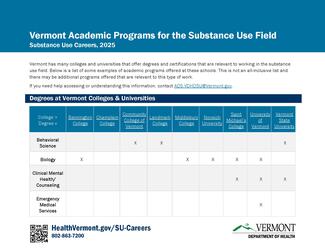
Degrees at VT Colleges and Universities

Vermont has many colleges and universities that offer degrees and certifications that are relevant to working in the substance use field.

This list includes some examples of academic programs offered at these schools.

This is not an all-inclusive list and there may be additional programs offered that are relevant to this type of work.

Download the Vermont Academic Programs document


Contact Us!

Substance Use Programs (DSU)

Vermont Department of Health
280 State Drive
Waterbury, VT 05671-8340

802-651-1550
[email protected]

Last Updated: